
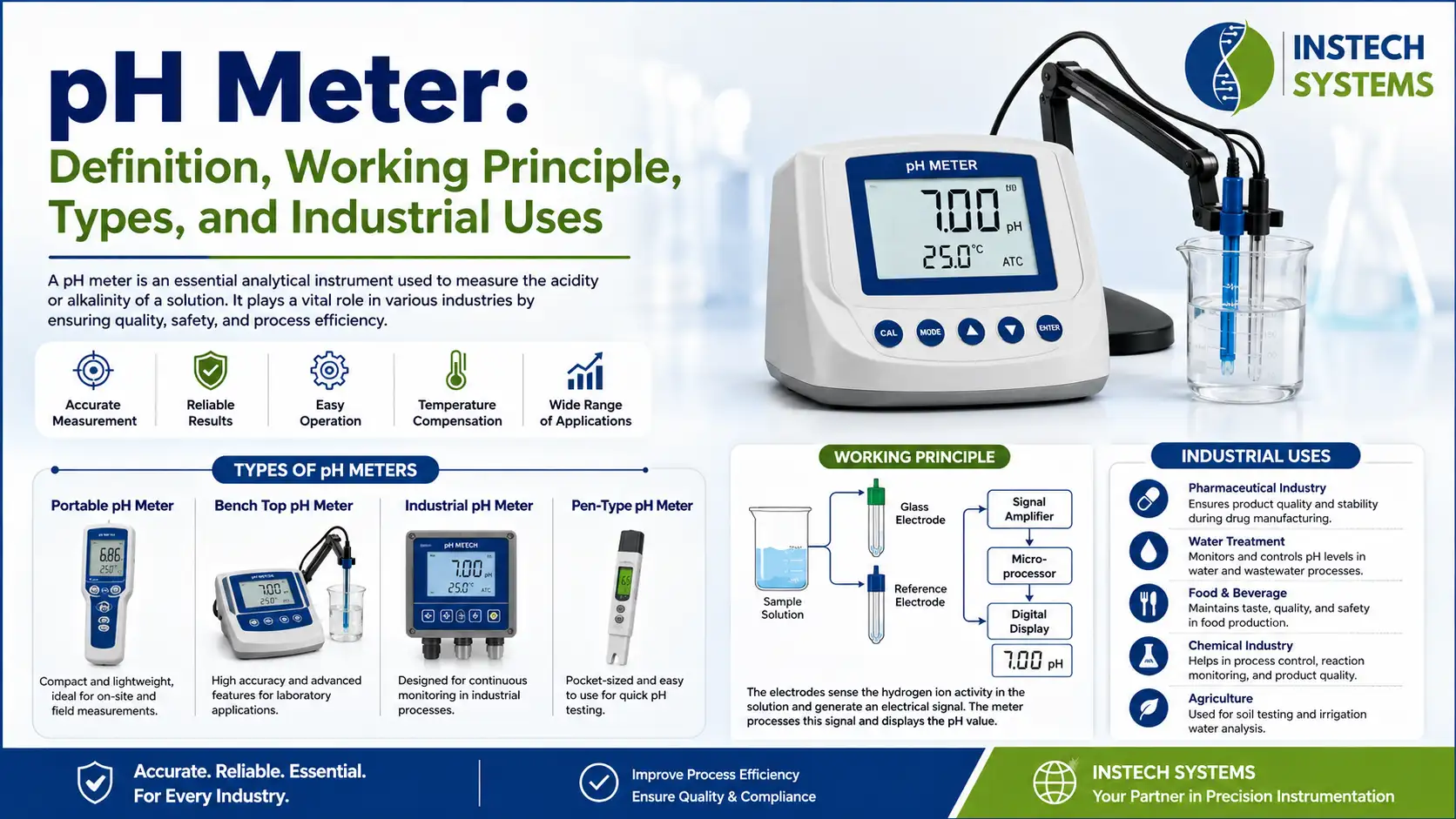
Maintaining accurate pH levels is essential in various industries, including pharmaceuticals, food processing, water treatment, chemical manufacturing, and laboratories. A pH meter is one of the most important analytical instruments used to measure the acidity or alkalinity of a solution. Accurate pH measurement helps ensure product quality, process efficiency, and compliance with industry standards.
From research laboratories to large-scale pharma industrial facilities, pH meters play a vital role in monitoring and controlling chemical processes. Understanding their working principle, types, and applications can help industries select the most suitable instrument for their requirements.
What is a pH Meter?
A pH meter is an electronic instrument used to measure the pH value of a liquid or semi-solid sample. The pH scale ranges from 0 to 14, where:
- pH below 7 indicates an acidic solution.
- pH 7 indicates a neutral solution.
- pH above 7 indicates an alkaline or basic solution.
The instrument provides accurate readings by detecting the hydrogen ion concentration present in the sample. Modern pH meters offer digital displays, high precision, and easy calibration, making them suitable for laboratory and industrial applications.
Working Principle of a pH Meter
A pH meter operates based on the electrochemical measurement of hydrogen ion activity in a solution. The instrument typically consists of a glass electrode and a reference electrode.
When the electrode is immersed in a solution, a voltage difference is generated due to the hydrogen ion concentration. This electrical potential is measured and converted into a pH value by the meter.
Basic Working Steps
- The electrode is immersed in the sample solution.
- Hydrogen ions interact with the glass membrane of the electrode.
- A voltage potential is generated.
- The pH meter measures this voltage.
- The instrument converts the signal into a pH reading and displays the result.
This process allows users to obtain accurate and reliable pH measurements within seconds.
Simple Internal Diagram of ph Meter
Sample Solution
│
▼
┌─────────────────┐
│ Glass Electrode │
└─────────────────┘
│
▼
┌─────────────────┐
│ Reference │
│ Electrode │
└─────────────────┘
│
▼
┌─────────────────┐
│ Signal Amplifier│
└─────────────────┘
│
▼
┌─────────────────┐
│ Microprocessor │
└─────────────────┘
│
▼
┌─────────────────┐
│ Digital Display │
│ pH Reading │
└─────────────────┘
Main Components of a pH Meter
A pH meter consists of several important components that work together to provide accurate readings.
Glass Electrode: The glass electrode is the sensing element responsible for detecting hydrogen ion concentration.
Reference Electrode: The reference electrode provides a stable reference voltage against which the measurement is compared.
Temperature Sensor: Many modern pH meters include automatic temperature compensation to improve measurement accuracy.
Electronic Amplifier: The amplifier processes weak electrical signals generated by the electrodes.
Display Unit: The display shows the measured pH value in an easy-to-read format.
Types of pH Meters
Different types of pH meters are available to suit various applications and operating environments.
Portable pH Meter
Portable pH meters are compact and lightweight instruments designed for field measurements.
Features
- Battery operated
- Easy to carry
- Quick measurements
- Suitable for outdoor applications
Applications
- Water testing
- Environmental monitoring
- Agriculture
Bench Top pH Meter
Bench top pH meters are commonly used in laboratories where high accuracy is required.
Features
- High precision
- Advanced calibration options
- Large digital display
- Stable measurements
Applications
- Research laboratories
- Pharmaceutical testing
- Chemical analysis
Industrial pH Meter
Industrial pH meters are designed for continuous monitoring in manufacturing processes.
Features
- Robust construction
- Continuous operation
- Process integration capability
- High durability
Applications
- Water treatment plants
- Chemical processing
- Food and beverage industries
Pen-Type pH Meter
These compact devices provide quick and convenient pH testing.
Features
- Pocket-sized design
- Easy operation
- Instant readings
Applications
- Aquariums
- Educational laboratories
- Basic testing applications
Industrial Uses of pH Meters
pH meters are widely used in numerous industries where process control and product quality are critical.
Pharmaceutical Industry
The pharmaceutical industry requires precise pH control during drug formulation and manufacturing processes. Accurate pH measurements help ensure product stability and compliance with regulatory standards.
Water Treatment Plants
Water treatment facilities use pH meters to monitor and maintain water quality. Proper pH control is essential for effective purification and chemical treatment processes.
Food and Beverage Industry
Food manufacturers rely on pH measurement to maintain product consistency, improve quality, and ensure food safety.
Chemical Industry
Chemical processing operations require continuous pH monitoring to optimize reactions and improve production efficiency.
Agriculture Sector
pH meters are used for soil testing and irrigation water analysis to support healthy crop growth and improved agricultural productivity.
Environmental Monitoring
Environmental laboratories use pH meters to analyze wastewater, surface water, and environmental samples.
Benefits of Using a pH Meter
The use of pH meters offers several advantages across laboratory and industrial applications.
- Accurate pH measurement
- Fast and reliable results
- Easy operation
- Improved process control
- Enhanced product quality
- Reduced testing errors
- Better regulatory compliance
- Long-term operational efficiency
Maintenance Tips for pH Meters
Proper maintenance helps ensure consistent performance and accurate measurements.
- Clean electrodes regularly.
- Store electrodes in recommended storage solutions.
- Calibrate the instrument periodically.
- Avoid electrode contamination.
- Replace damaged electrodes promptly.
- Follow manufacturer maintenance guidelines.
Routine maintenance significantly improves instrument lifespan and measurement accuracy.
Instech Pharma – Reliable Bioreactor/Fermenter Manufacturers in India
Instech Pharma is a trusted supplier of advanced laboratory and industrial instruments designed to meet the needs of pharmaceutical, chemical, research, and quality control applications. The company offers reliable analytical solutions that help industries achieve accurate measurements, efficient process control, and consistent product quality.
With a focus on innovation, precision, and customer satisfaction, we provide high-quality instruments that comply with modern industry standards. Our commitment to quality and technical excellence makes them a preferred as Bioreactor and Fermenter Manufacturer in India.
Conclusion
A pH meter is an essential instrument for measuring acidity and alkalinity in laboratory and industrial applications. By providing accurate and reliable pH readings, these instruments help maintain product quality, improve process efficiency, and support regulatory compliance.
Whether used in pharmaceuticals, water treatment, food processing, chemical manufacturing, or environmental monitoring, pH meters play a crucial role in ensuring operational success. Choosing high-quality instruments from trusted suppliers like Instech Pharma can help organizations achieve dependable performance and long-term value.