Sterilization is an important process used in pharmaceutical, medical, and food industries to protect products and equipment from harmful microorganisms. ETO (Ethylene Oxide) sterilization is one of the widely used low-temperature sterilization processes, especially for heat-sensitive medical and pharmaceutical products.
Ethylene Oxide (ETO) sterilization is one of the widely used low-temperature sterilization methods for medical devices, pharmaceutical products, and other heat- and moisture-sensitive items that cannot withstand conventional heat-based sterilization. Its ability to penetrate packaging and complex product surfaces makes ETO suitable for various sensitive applications. Instech Systems specializes in providing reliable ETO sterilizers designed for controlled, safe, and efficient sterilization processes across different industries.
What is ETO Process? Full Form of ETO
Full Form of ETO
ETO stands for Ethylene Oxide.
Ethylene Oxide (ETO) is a chemical gas widely used for sterilization, especially for medical devices, pharmaceutical products, and other heat-sensitive materials. ETO sterilization works by destroying microorganisms such as bacteria, viruses, and fungi without exposing products to high temperatures.
ETO Sterilizer, sterilization system that uses ethylene oxide gas, a colourless and flammable gas, to sterilize heat-sensitive products. ETO sterilization efficiently works at relatively low temperatures, and destroys bacteria, viruses, fungi, and other microorganisms by disrupting their cellular structure making it suitable for materials that may be damaged by high temperature or humidity.
ETO Sterilizer Working Principle
The working principle of an ETO sterilizer is based on the ability of ethylene oxide gas to penetrate packaging and interact with microorganisms. During the sterilization cycle, the products are exposed to a controlled concentration of ETO gas under specified temperature and humidity conditions.
The gas penetrates into product surfaces and packaging materials and helps inactivate microorganisms. After the required exposure period, the chamber is evacuated and the products undergo an aeration stage to remove residual ETO before they are handled or used.
Steps of the ETO Sterilizer Process
1. Preconditioning
Products are prepared under controlled temperature and humidity conditions. Proper humidity can help improve the effectiveness of ETO gas penetration.
2. Loading
The products are arranged inside the sterilization chamber. Proper loading allows the gas to circulate and reach the required surfaces.
3. Vacuum
Air is removed from the chamber to create controlled conditions for the sterilization cycle and facilitate gas penetration.
4. ETO Gas Injection
A controlled quantity of ethylene oxide gas is introduced into the chamber. The temperature, pressure, humidity, and gas concentration are monitored during the cycle.
5. Exposure
Products remain exposed to ETO gas for a specified period. During this stage, the gas penetrates packaging and product surfaces to achieve the required microbial inactivation.
6. Gas Removal
After the exposure period, the chamber is evacuated to remove ETO gas from the sterilization environment.
7. Aeration
The sterilized products are kept under controlled aeration conditions to reduce residual ETO to acceptable levels before further handling or use.
Applications of ETO Sterilization
ETO sterilization is commonly used for heat-sensitive products and equipment, including:
- Medical devices
- Surgical instruments
- Catheters and tubing
- Plastic healthcare products
- Pharmaceutical packaging components
- Laboratory products
- Disposable medical products
- Components that cannot withstand steam sterilization
Benefits of ETO Sterilization
Effective for Heat-Sensitive Materials: ETO sterilization is suitable for materials that cannot withstand high temperatures, such as plastics, rubber, polymers, and certain medical devices.
Wide Range of Applications: ETO sterilization is used in healthcare, pharmaceutical, biotechnology, and other industries for sterilizing medical devices, packaging materials, and heat-sensitive products.
Penetrates Complex Geometries: Ethylene oxide gas can penetrate porous materials, narrow spaces, and complex device structures, helping achieve effective sterilization.
Minimal Impact on Material Integrity: Since ETO sterilization is performed at relatively low temperatures, it can be suitable for products that may be damaged by conventional high-temperature sterilization methods.
Effective Against Various Microorganisms: ETO can inactivate a broad range of microorganisms, including bacteria, viruses, fungi, and bacterial spores, when the process is properly controlled.
Critical Parameters for Effective ETO Sterilization
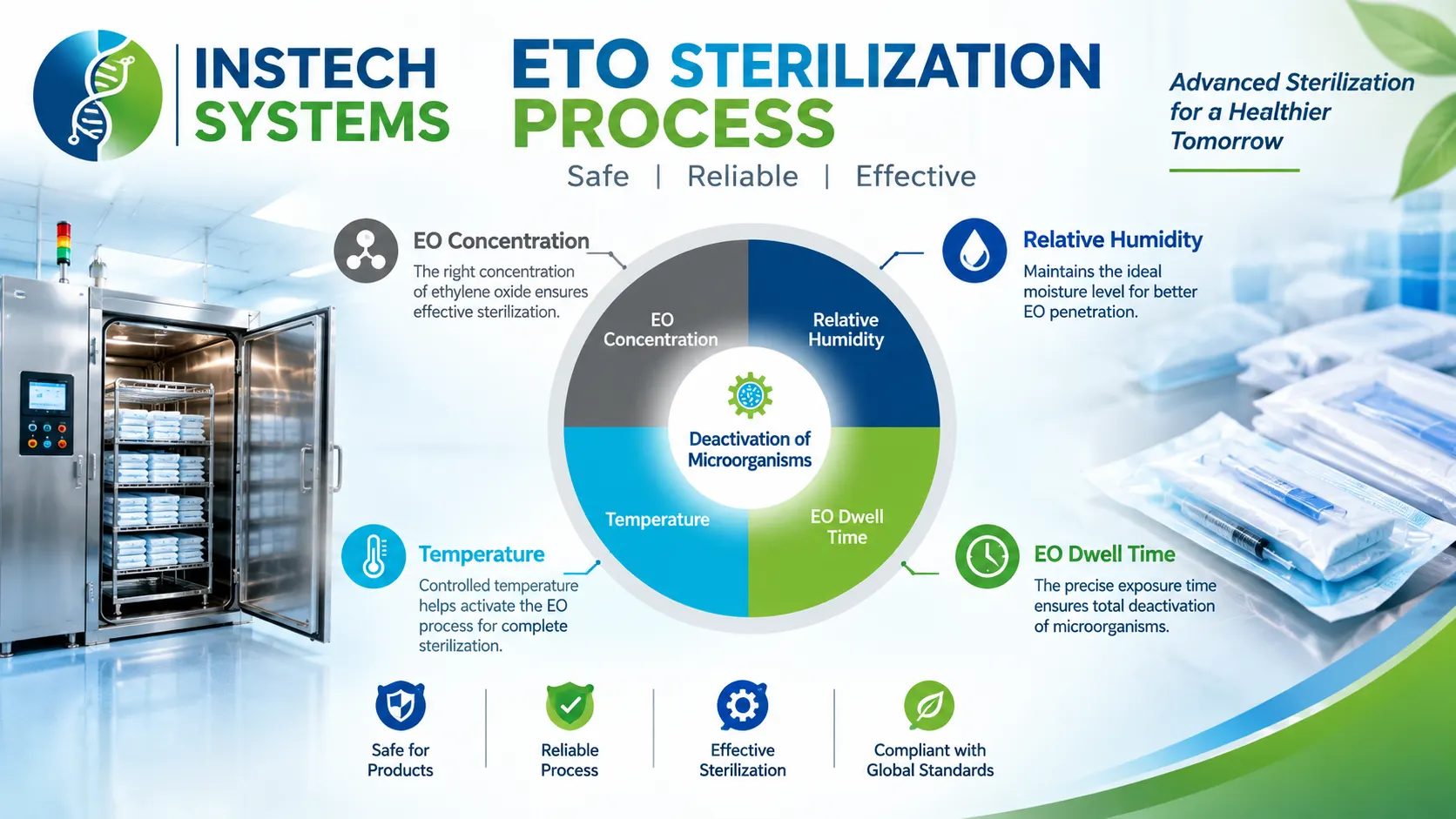
The effectiveness of ETO sterilizer process depends mainly on four controlled parameters: ETO gas concentration, temperature, relative humidity, and exposure time. Proper control of these factors helps the gas penetrate the product effectively and achieve reliable microbial inactivation. Proper packaging, gas diffusion, and aeration are also essential for a successful ETO sterilization cycle.
Why Choose Instech Pharma for ETO Sterilization Process Equipment?
Instech Pharma, a well recognized name in the pharmaceutical industry for developing pharmaceutical and industrial equipment with attention to process requirements, controlled operation, and equipment reliability. An ETO sterilization system needs appropriate chamber design, process controls, safety provisions, and monitoring to support consistent sterilization cycles.
For pharmaceutical and healthcare applications, selecting an ETO sterilizer according to product material, load configuration, sterilization requirements, and applicable standards is important.
We are a trusted and experienced manufacturer of pharmaceutical equipment, providing reliable solutions for various pharmaceutical processing and manufacturing requirements.
Conclusion
ETO Sterilizer Process involves several controlled stages, including preconditioning, vacuum, ETO gas injection, exposure, gas removal, and aeration. Because ETO sterilization operates at relatively low temperatures, it can be used for many heat-sensitive medical and pharmaceutical products.
As an experienced Fermenter or Bioreactor Manufacturer, we also provide equipment designed for controlled pharmaceutical and biotechnology processing applications.