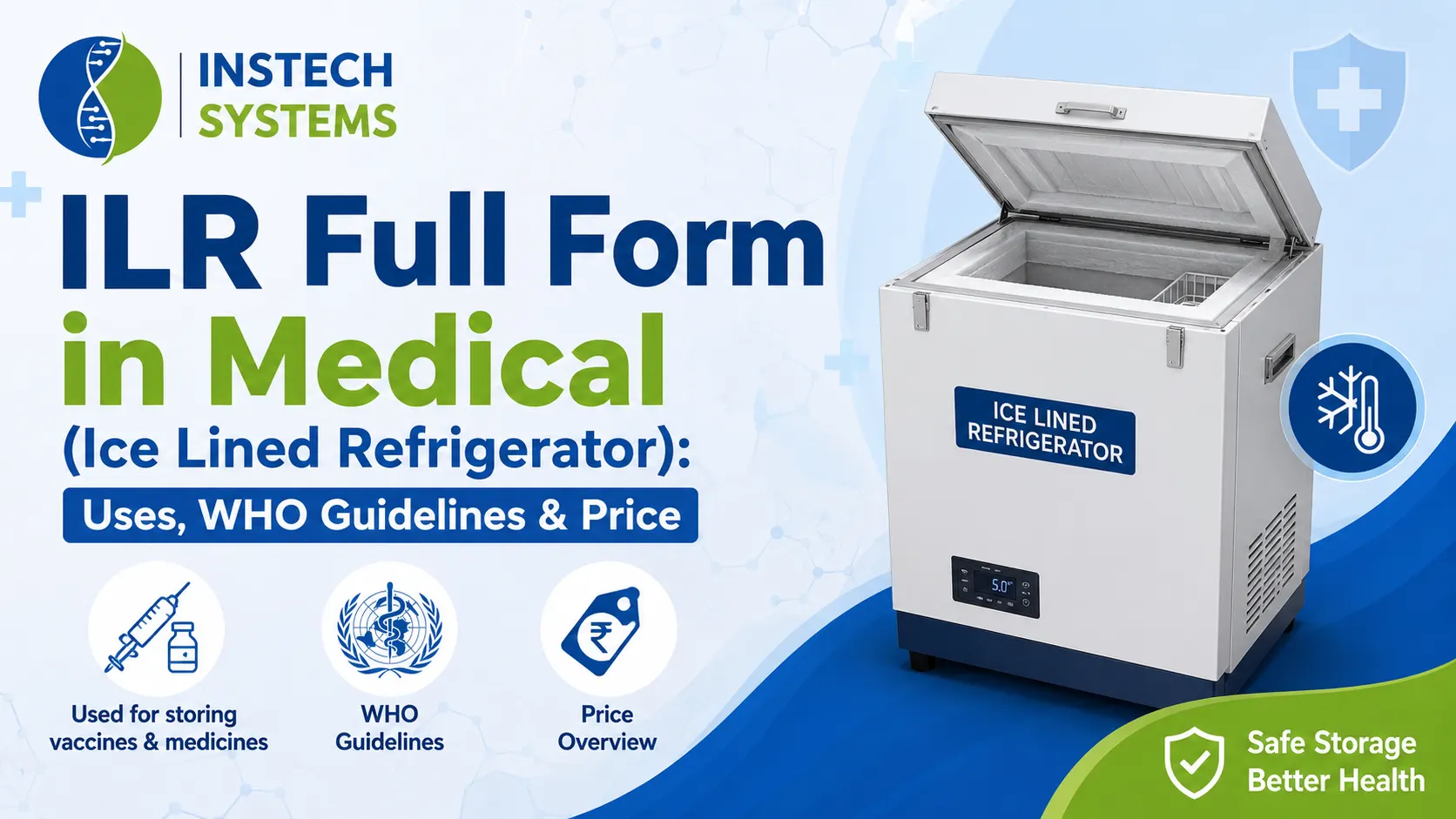
In the medical and healthcare sector, ILR stands for Ice Lined Refrigerator. It is a specialized refrigeration system primarily used for storing vaccines and other temperature-sensitive biological products. An ILR is designed to maintain a controlled temperature inside its storage compartment, helping protect vaccines from excessive heat and accidental freezing.
According to WHO guidance, vaccine refrigerators such as ILRs are designed to maintain the vaccine storage area within the recommended +2°C to +8°C range. The ice-lined or coolant-lined construction also helps maintain safe temperatures during power interruptions.
ILR Full Form in Medical: WHO Guidelines and Standards
ILR full form in medical is Ice-Lined Refrigerator. It is a specialized refrigeration system used mainly for storing vaccines and other temperature-sensitive medical products under controlled conditions. Unlike a conventional refrigerator, an ILR is designed with an internal ice or phase-change material lining that stores cooling energy and helps maintain the required temperature during power interruptions.
For vaccine storage, the acceptable temperature range is generally +2°C to +8°C. WHO’s immunization-device programme classifies ice-lined refrigerators under E003: Refrigerators and Freezers and provides performance and quality requirements for products used in immunization programmes.
Instech Pharma provides pharmaceutical and healthcare equipment solutions, including refrigeration equipment for applications where controlled temperature storage is required.
What Is an Ice-Lined Refrigerator (ILR)?
An Ice-Lined Refrigerator (ILR) is a cold-chain refrigeration unit designed primarily for the safe storage of vaccines. Its internal lining contains ice, cold water, frozen ice packs, or suitable phase-change material. This lining acts as a thermal reserve and helps keep the vaccine compartment cool when electrical power is temporarily unavailable.
The main purpose of an ILR is to maintain stable storage conditions and reduce the risk of temperature excursions that could affect temperature-sensitive vaccines.
WHO identifies the ILR as a subtype of electric vapor-compression refrigeration technology.
WHO Guidelines for Ice-Lined Refrigerators
WHO’s Performance, Quality and Safety (PQS) programme evaluates immunization equipment against defined performance requirements. ILRs fall under the E003 category of WHO-prequalified refrigerators and freezers.
Important requirements and performance considerations include:
| Parameter | Requirement / Consideration |
|---|---|
| Vaccine storage temperature | +2°C to +8°C |
| Product category | E003 – Refrigerators and Freezers |
| Freeze protection | Required for applicable vaccine refrigerators |
| Holdover performance | Model-specific and tested under defined conditions |
| Application | Vaccine and immunization cold-chain storage |
| Power source | Commonly electric mains; other technologies are also covered under E003 |
The exact holdover time is not a universal 20–70 hours requirement. It varies by model and WHO test results. For example, current WHO listings show different prequalified ILRs with different autonomy/holdover values.
How Do Icelined Refrigerators Work?
The ice-lined design is more than just additional insulation. It works as a thermal energy storage system.
The lining: The refrigerator has an internal lining surrounding the vaccine storage compartment. Depending on the model, this may contain ice, cold water, frozen ice packs, or phase-change material.
The cooling cycle: When electricity is available, the refrigeration system removes heat and cools/freezes the material within the lining.
The cold reserve: The lining stores cooling energy while the refrigerator operates normally.
During a power failure: When the compressor stops, the cold lining absorbs incoming heat and helps slow the rise in cabinet temperature.
Temperature protection: The design helps the vaccine compartment remain within its specified operating range for a period determined by the model’s tested performance.
WHO notes that many ILRs can maintain temperatures below +8°C with as little as approximately eight hours of electricity per 24 hours, making them useful where a reliable standby power supply is not available.
WHO Prequalification (PQS) — What It Means for Ice-Lined Refrigerators
WHO PQS prequalification indicates that an immunization device has been evaluated against the applicable WHO performance, quality, and safety requirements.
For ILRs, WHO evaluates factors such as:
- Temperature performance
- Freeze protection
- Holdover performance
- Operation under specified ambient conditions
- Energy performance
- Refrigeration technology
- Vaccine storage capacity
- Construction and other applicable specifications
WHO maintains an online listing of products under the E003 refrigerator and freezer category. Each listed product is assigned a unique IMD-PQS code, allowing users to distinguish individual prequalified products.
For example, WHO currently lists products such as the GHR 60 AC and GHR 120 AC as prequalified ice-lined refrigerators. Their published specifications include Grade A freeze protection and model-specific holdover performance.
How to Verify WHO PQS Certification?
Before purchasing an ILR advertised as “WHO PQS approved” or “WHO prequalified,” it is important to verify the claim rather than relying only on a supplier’s marketing material.
Step 1: Visit the WHO Immunization Devices Listing
Open the official WHO list of prequalified immunization devices and navigate to the E003 – Refrigerators and Freezers category.
Step 2: Search the Product or Manufacturer
Search using the:
- Product name
- Manufacturer name
- Manufacturer reference
- IMD-PQS code
Step 3: Check the Product Status
The product page should identify its PQS/IMD status, product details, manufacturer, and applicable specifications.
Step 4: Check the Validity
Look at the product’s acceptance date and valid-until date. PQS status is associated with a specific product and approval period, so an older certificate should not automatically be treated as current.
Step 5: Compare the Technical Specifications
Check the listed:
- Vaccine storage capacity
- Freeze-protection grade
- Holdover time
- Climate zone
- Tested ambient temperature
- Energy source
- Refrigeration cycle
- Applicable PQS specification
This is more reliable than simply accepting a statement that a refrigerator is “WHO certified.”
Uses of Ice-Lined Refrigerators
ILRs are primarily associated with vaccine cold-chain storage. They are useful at healthcare facilities and other locations where vaccines need to remain within controlled temperature conditions.
Vaccine Storage: The most important use of an ILR is storing vaccines at the recommended temperature. Maintaining appropriate temperature conditions helps protect vaccine quality throughout the storage period.
Immunization Centres: Government and private immunization centres can use ILRs for routine vaccine storage and management.
Hospitals and Healthcare Facilities: Hospitals may require specialized refrigeration equipment for vaccines and other temperature-sensitive healthcare products.
Primary Healthcare Centres: ILRs can be useful at healthcare facilities where electricity availability may be intermittent. Their stored cooling capacity provides additional protection during power interruptions.
Vaccine Distribution Centres: Larger-capacity refrigerators can form part of vaccine distribution and cold-chain infrastructure, depending on the storage requirements of the facility.
Remote Healthcare Locations: Where electricity supply is available for limited periods, an appropriately designed ILR can provide useful thermal storage between electricity cycles. WHO specifically identifies ILRs as a suitable option where around eight hours of electricity per day is available but standby power is not.
Important Features of an Ice-Lined Refrigerator
Modern ILRs may incorporate several features intended to improve cold-chain management:
- Controlled vaccine storage temperature
- Ice or PCM-lined construction
- Freeze protection
- Temperature display
- Temperature monitoring
- Alarm system
- Insulated cabinet
- Vaccine storage baskets
- Lockable design
- Energy-efficient refrigeration
- Power-failure protection
- Model-specific holdover capability
The actual features and performance should always be checked against the manufacturer’s technical documentation and, where applicable, the WHO PQS listing.
ILR Temperature Range
For vaccine storage, +2°C to +8°C is the key temperature range referenced in WHO specifications. WHO’s ice-lined refrigerator performance specification also defines the acceptable vaccine storage range and includes requirements concerning excursions and freeze protection.
Temperature should be continuously or regularly monitored using an appropriate temperature-monitoring device. Vaccines should also be arranged according to applicable immunization programme procedures rather than simply filling the refrigerator without considering airflow and storage requirements.
Ice-Lined Refrigerator vs Normal Refrigerator
An ordinary household refrigerator and a medical ILR are not interchangeable.
A domestic refrigerator is designed for food storage, while an ILR is purpose-built for vaccine cold-chain applications. Medical refrigerators are evaluated for temperature performance and other characteristics relevant to vaccine storage.
WHO warns that the performance shortcomings of domestic appliances can compromise the integrity of the cold chain and cause vaccine losses.
Therefore, healthcare facilities should select appropriate medical refrigeration equipment based on their cold-chain requirements.
Factors to Consider Before Buying an ILR
Before selecting an Ice-Lined Refrigerator, consider:
- Required vaccine storage capacity
- Temperature range
- Freeze-protection performance
- Holdover/autonomy requirement
- Ambient operating temperature
- Electricity availability
- Energy consumption
- Temperature monitoring
- Alarm system
- Internal storage arrangement
- Manufacturer support
- Spare-parts availability
- Warranty
- Applicable WHO PQS requirements
For organizations procuring equipment for immunization programmes, checking the current WHO product listing is particularly important.
ILR Refrigerator Price List in India – 2026
| ILR Capacity / Type | Approx. Price in India | Typical Application |
|---|---|---|
| 50–100 Litres | ₹25,000 – ₹45,000 | Small clinics and healthcare facilities |
| 100–150 Litres | ₹40,000 – ₹70,000 | Health centres and laboratories |
| 150–200 Litres | ₹55,000 – ₹1,00,000 | Hospitals and vaccine storage |
| 200–300 Litres | ₹70,000 – ₹1,50,000 | Larger healthcare facilities |
| 300–500 Litres | ₹1,00,000 – ₹2,50,000+ | High-volume vaccine and pharmaceutical storage |
| Solar ILR | ₹90,000 – ₹1,50,000+ | Remote and off-grid healthcare locations |
| Premium / WHO-PQS models | Model dependent | Immunization and specialized cold-chain applications |
Prices are indicative 2026 market ranges and can vary according to manufacturer, configuration, GST, transportation, installation, warranty, and procurement quantity. Current Indian listings show examples around ₹38,000 for a 108 L model, ₹55,000 for an ILR, ₹60,000 for a 300-class horizontal unit, and ₹1.30 lakh for a 150 L model.
Conclusion
The ILR full form in medicine is Ice-Lined Refrigerator. It is an important cold-chain equipment used primarily for vaccine storage under controlled temperature conditions.
Its ice or phase-change-material lining stores cooling energy and helps maintain the internal temperature during temporary power interruptions. WHO classifies ILRs under E003 – Refrigerators and Freezers and maintains a current database of prequalified products and their technical specifications.
For healthcare and pharmaceutical applications, Instech Pharma provides equipment solutions while helping customers identify refrigeration systems according to their operational requirements. Before purchasing an ILR, always verify its WHO PQS status, product code, validity, temperature performance, freeze protection, and holdover specifications from the official WHO listing.